- Education
Components that sustain life’s activities: Let’s take a peek into the world of proteins in 3D space — Plant photosynthesis.
- Institute for Protein Research, The University of Osaka
About
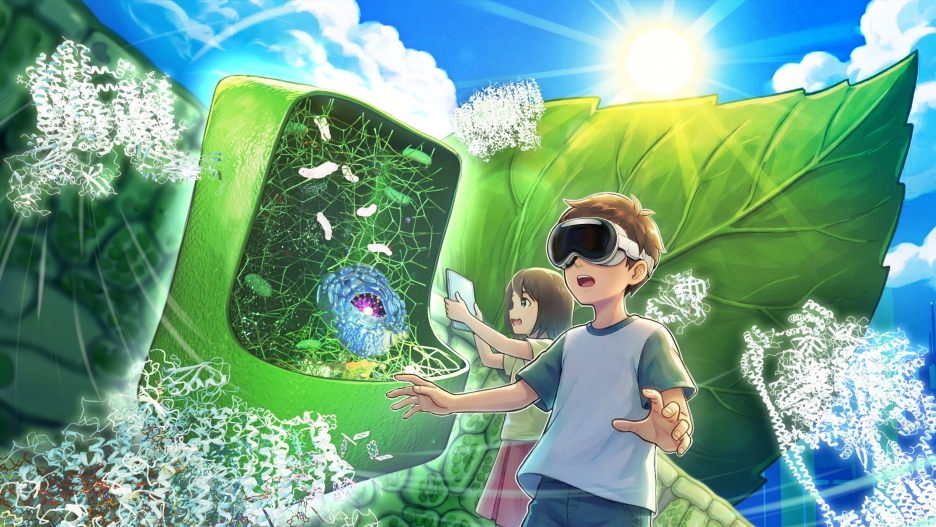
As Specially Appointed Lecturer Noriko Nakayama of the Institute for Protein Research, The University of Osaka, prepares to exhibit at the Japan Science and Technology Agency (JST)’s “Science Agora 2025,” MESON was responsible for planning and developing the MR educational app “Components that Sustain Life’s Activities: Let’s Take a Peek into the World of Proteins in 3D Space — Plant Photosynthesis.” This educational content is primarily aimed at junior high and high school students, with the goal of promoting understanding of life science research.
Using Apple Vision Pro or an iPad, participants can learn in three dimensions about the structures and roles of leaves, cells, and proteins through 3D models and video explanations overlaid onto the real world. Leveraging the virtual showroom solution “Immersive Showroom,” which enables synchronized playback across multiple devices, the experience was designed as a group-based exhibit in which up to seven people can view the same content simultaneously using a single controller.
Background
Specially Appointed Lecturer Noriko Nakayama of the Institute for Protein Research, The University of Osaka, had been developing an exhibition plan for JST’s Science Agora 2025 under the Japan Science and Technology Agency (JST) “Program to Foster and Promote the Activities of Program Managers,” with the theme of “lowering the barriers to unfamiliar fields of study and helping people feel life science research as something close to them.” In particular, the functions of proteins involved in plant photosynthesis are a topic that is difficult for junior high and high school students to picture, because textbooks do not easily convey the scale and three-dimensional structures of proteins.
In response, MESON proposed an MR educational approach that leverages spatial computing technology: a structure that gradually zooms in from the surface of a leaf to the cells inside, and then down to the protein level, enabling learners to understand “where and what is happening” together with a spatial sense. In addition, by synchronizing playback across multiple devices to create a setting where the presenter and participants can share the same visuals at the same time, we aimed to provide a learning experience that makes it easier to deepen understanding even within the limited time available at an event.
Execution
In this project, under the supervision of Specially Appointed Lecturer Noriko Nakayama of the Institute for Protein Research, The University of Osaka, MESON handled the work end-to-end—from proposing the on-screen content and designing the experience scenario, to UX design, production and adjustment of 3D assets, narration recording, and application development.
The content begins with the title screen and then unfolds into an overview of photosynthesis, a gradual zoom into the inside of a leaf, a structural explanation using a diagram of leaf cells, and an explanation of the inside of a plant cell. From there, the functions of proteins involved in photosynthesis are introduced through 3D models and narration, and finally the experience zooms back out to the real world and displays credits. This structure enables users to continuously experience the sense of scale from macro (leaves/plants) to micro (cells/proteins).
On the technical side, the experience is built on “Immersive Showroom,” connecting a controller app and viewer apps (iPad / Apple Vision Pro) via peer-to-peer communication, enabling real-time transmission and reception of control signals such as scene switching and playback timing. This allows the presenter to centrally operate the progression of the content while delivering the same synchronized MR experience to up to seven participants.
Execution
This content, as well as the underlying virtual showroom solution “Immersive Showroom,” can be deployed in a wide range of settings—not only at science events such as Science Agora, but also for research showcases at universities and research institutes, and for science education content in various contexts.
Going forward, MESON will build on the insights gained through this project to explore expressions and MR content possibilities that help deepen understanding of “invisible worlds.”
Credit
- Producer
- Yuki Kobayashi
- Director
- Gaku Shimizu, Kazuaki Saito
- Designer
- Yuji Higashida
- Engineer
- Tsuyoshi Takano
- Narration
- Haruka Kumagai
See More Cases 📕
